1. What a mirror-image question asks
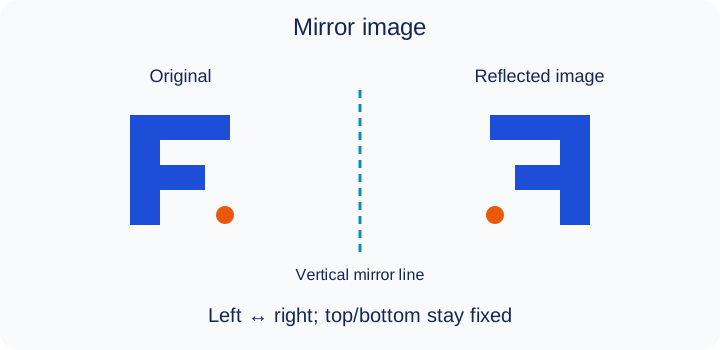
A mirror-image question asks you to reflect a printed figure across a specified line. In the usual reasoning question the mirror stands vertically on the left or right. The image then swaps left and right while preserving top and bottom. This chapter uses that two-dimensional exam convention; the direction of the drawn mirror line always decides the transformation.
Every point and its image lie on opposite sides of the mirror line at the same perpendicular distance. Size, lengths, angles, colour and the number of parts remain unchanged. A point on the mirror line stays in place. A mirror drawn above or below the figure produces a top–bottom reflection, which reasoning books usually call a water image.
2. Direction and position rules
| Original feature | Image in a vertical mirror |
|---|---|
| Left / right | Right / left |
| Top / bottom | Top / bottom |
| Top-left corner | Top-right corner |
| Bottom-left corner | Bottom-right corner |
| Arrow → / ← | ← / → |
| Arrow ↑ / ↓ | ↑ / ↓ |
| Arrow ↗ / ↘ | ↖ / ↙ |
| Slash / | Backslash \ |
A circle at the top-left of a box goes to the top-right. It stays near the top. If an arrow is attached to that circle, reflect both the circle's position and the arrow's direction. If the mirror is moved from the right of the object to its left, the image is placed on the other side, but its left–right orientation is still reversed.
The nearest-point check
A part 1 cm from the mirror has its image 1 cm behind the mirror. A part 4 cm away has its image 4 cm behind it. The nearest part stays nearest; it is not exchanged with the farthest part by distance from the mirror. The distance from a point to its image is twice its distance from the mirror.
3. Capital letters: learn the rule behind the list
For conventional, upright, ideal block capitals, the following 11 letters have vertical symmetry:
A, H, I, M, O, T, U, V, W, X, Y
The remaining 15 letters change:
B, C, D, E, F, G, J, K, L, N, P, Q, R, S, Z
N must be included in the changing list. N, S and Z can have 180-degree rotational symmetry in ideal lettering, but they do not have vertical reflection symmetry. Rotating a figure and reflecting it are different operations.
| Symmetry in conventional block capitals | Letters |
|---|---|
| Vertical only | A, M, T, U, V, W, Y |
| Horizontal only | C, D, E, K |
| Both vertical and horizontal | H, I, O, X |
| Neither of these two axes | B, F, G, J, L, N, P, Q, R, S, Z |
These are exam drawing conventions, not rules for every font. A decorative A, an italic I or an uneven M may break the expected symmetry. Judge the actual outline in the question. Lowercase and handwritten letters need separate inspection.
4. Digits and symbols
In common exam drawings, 0 and 8 are unchanged in a vertical mirror. The digits 1, 2, 3, 4, 5, 6, 7 and 9 generally change in the familiar printed style with an asymmetric 1. A plain vertical-stroke 1 is unchanged, so a question must show or describe the glyph. A slashed 0 or an unevenly drawn digit also requires inspection.
Do not replace a reflected 6 with a normal 9. A vertical reflection is not a half-turn. Similarly, a reflected 3 has its opening on the opposite side and should not be written as a normal 3.
Symmetric circles and squares stay the same shape, but their positions in a group can change. A dot, a shaded corner or a cut in a square can destroy the symmetry of the complete figure.
5. Words, numbers and mixed strings
Reflect a horizontal string in two steps:
- Reverse the left-to-right order of its characters.
- Reflect the shape of every individual character.
For ABC, the image positions contain the reflection of C, then the reflection of B, then the reflection of A. Plain CBA shows the position order only; normal C and B have not yet been reflected.
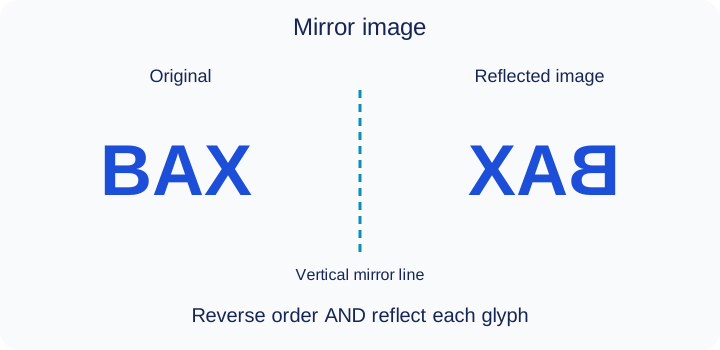
When every glyph is vertically symmetric, ordinary letters can show the answer: MATH → HTAM in ideal block lettering. Even though each letter stays unchanged, the entire word changes because its order changes.
A whole horizontal string is unchanged only if the reflected glyph at each position matches the original glyph at that position. With the 11 vertically symmetric capitals, this reduces to a palindrome test: MOM, WOW and TOOT stay unchanged; MATH does not. A palindrome containing asymmetric letters, such as BOB, does not automatically stay unchanged.
Rows and columns
For a rectangular arrangement, reverse the columns within each row. Keep the rows in their original top-to-bottom order. The following circles are symmetric, so only their positions need to change:
Original        Mirror image
● ○ ○           ○ ○ ●
○ ● ●           ● ● ○
6. A reliable method for figure questions
- Locate the mirror line. Check whether it is vertical, horizontal or slanting.
- Pick an asymmetric feature: arrowhead, gap, dot, shaded corner or unequal arm.
- Move that feature to the opposite side at equal perpendicular distance.
- Check a second feature and the top–bottom position.
- Reject choices that rotate the figure, change its size or move only part of it.
- Inspect small details before answering: a dot or arrowhead often separates two otherwise similar options.
Use one decisive feature to eliminate choices quickly, then verify the whole figure. Reflecting only the outline while leaving the internal dot unchanged is a common error.
7. Coordinates and grid positions
On ordinary Cartesian axes, x increases to the right and y increases upward.
| Mirror line | Point transformation |
|---|---|
| y-axis, x = 0 | (x, y) → (−x, y) |
| Vertical line x = a | (x, y) → (2a − x, y) |
Example: reflect (2, 5) in x = 7. The point is 5 units left of the line, so its image is 5 units right at (12, 5). The midpoint of the pair has x = 7.
For an R-row, C-column grid, numbered from the top-left, a vertical reflection of the grid layout sends (row r, column c) → (r, C + 1 − c). This describes the arrangement within the reflected grid; the whole image grid lies across the mirror line. In a 5-column grid, column 2 becomes column 4. The row does not change.
8. Mirror images of analogue clocks
For a standard 12-hour analogue clock, a vertical reflection reverses each hand's angular position. When the reflected hand positions are interpreted against a normal clock face, the familiar relation is:
Mirror reading = 12:00 minus the original reading, modulo 12 hours.
For nonzero minutes, write the subtraction as 11:60 − h:mm. Use borrowing correctly. Treat 12 as 0 when calculating, then display 0 hours as 12.
| Original reading | Reflected hand reading |
|---|---|
| 3:40 | 8:20 |
| 7:25 | 4:35 |
| 12:15 | 11:45 |
| 6:00 | 6:00 |
At an exact hour, subtract from 12:00 directly: 4:00 → 8:00. The transformation works in reverse too, so a mirror reading of 8:20 corresponds to an actual time of 3:40. This shortcut assumes a normal analogue clock and a vertical mirror. It is not a rule for reflecting the printed digits of a digital display.
9. Repeated reflections and harder cases
Twice across the same line: the figure returns to its original position and orientation. An even number of reflections in that same line restores it; an odd number gives one reflection.
Vertical then horizontal through the same centre: both coordinates change sign relative to that centre. The result equals a 180-degree rotation about the intersection of the two perpendicular lines. The reverse order gives the same result in this case.
Two different parallel vertical lines: the result is a translation. If the first line is x = a and the second is x = b, then x becomes x + 2(b − a). It does not generally return to the starting position.
Slanting lines: use perpendicular distances. Reflection in y = x sends (x, y) to (y, x); reflection in y = −x sends it to (−y, −x). The simple left–right shortcut applies only to a vertical line.
10. Worked examples
Example 1 — a shaded corner
A square has its bottom-right quarter shaded. Its vertical-mirror image has the bottom-left quarter shaded. The shading remains at the bottom.
Example 2 — an arrow and a dot
A box has a dot at the top-left and an arrow pointing ↘. After reflection, the dot is at the top-right and the arrow points ↙. Both position and direction must pass the check.
Example 3 — symmetric letters in a word
MATH uses only vertically symmetric block letters. Reverse the order to obtain HTAM. The letters need no further visible change under the stated convention.
Example 4 — an asymmetric letter
For BAX, the order becomes X, A, B. The final B must have its vertical stem on the right, with its curves facing left. Writing ordinary XAB is incomplete.
Example 5 — a grid position
A mark is at row 2, column 3 in a 4-row, 7-column grid. Its image position is (2, 5) because 7 + 1 − 3 = 5.
Example 6 — distance to the image
A point is 6 cm from the mirror. Its image is 6 cm beyond the line, so point-to-image separation is 12 cm. The distance to the mirror is not 12 cm.
Example 7 — a clock
For 9:35, calculate 11:60 − 9:35 = 2:25. The minute reading becomes 25 and the hour hand lies between 2 and 3 in the correct position.
Example 8 — two parallel mirrors as successive transformations
Reflect (1, 4) in x = 3, then in x = 7. The intermediate point is (5, 4); the final point is (9, 4). The total shift is 2(7 − 3) = 8 units right.
11. Quick revision and common mistakes
- Vertical mirror: swap left/right; preserve top/bottom.
- Preserve size, colour, angles and distance from the mirror line.
- The changing-capital list contains N and has 15 letters under the stated block-letter convention.
- Check the actual font, especially the digit 1 and decorative letters.
- Reverse a horizontal string's order and reflect its glyphs.
- An unchanged letter does not imply an unchanged word.
- A half-turn changes both left/right and top/bottom; a vertical reflection changes only left/right.
- Do not apply the analogue-clock formula to digital digits or water images.
- Before choosing an option, check one asymmetric feature and then a second small detail.
Practice set: 30 questions
Try these before reading the answer explanations. The online tests contain 80 questions, including these practice items.
Practice 01
Which pair is exchanged by reflection in a vertical mirror?
- A. Left and right
- B. Top and bottom
- C. Size and colour
- D. Length and width in every figure
Practice 02
A dot is in the top-left corner of a box. Where is it in a vertical-mirror image?
- A. Top-left
- B. Top-right
- C. Bottom-left
- D. Bottom-right
Practice 03
A point is 7 cm from a vertical mirror. How far is its image from the mirror?
- A. 3.5 cm
- B. 0 cm
- C. 7 cm
- D. 14 cm
Practice 04
An object point is 9 cm from a mirror. What is the separation between the point and its image?
- A. 9 cm
- B. 4.5 cm
- C. 27 cm
- D. 18 cm
Practice 05
What happens to a point lying exactly on the mirror line?
- A. It stays in place
- B. It moves twice its height
- C. It disappears
- D. It must move left
Practice 06
Which set contains only vertically symmetric conventional block capitals?
- A. N S Z R
- B. F G J L
- C. A H M T
- D. B C D E
Practice 07
A digit 1 is drawn as a plain vertical line with no hook or base. What does a vertical reflection do to its shape?
- A. Unchanged
- B. It becomes 7
- C. It becomes a horizontal line
- D. It must change because every 1 changes
Practice 08
With vertically symmetric block M and O, which whole string remains unchanged in a vertical mirror?
- A. TOY
- B. HAT
- C. MOM
- D. MATH
Practice 09
Why is BOB not automatically unchanged in a vertical mirror?
- A. It has three characters
- B. O always changes
- C. Palindromes always rotate
- D. Its B glyphs are not vertically symmetric
Practice 10
Which feature is preserved by an ideal plane reflection?
- A. The reading order of every word
- B. Lengths and angles
- C. Every left-right position
- D. Only the outer border
Practice 11
A vertical mirror is moved from the right side of a drawing to its left. What remains true about the image orientation?
- A. Left and right are still exchanged
- B. Now only top and bottom exchange
- C. It becomes a half-turn
- D. All glyphs become unchanged
Practice 12
Which item needs a separate glyph check rather than the analogue clock subtraction rule?
- A. Hour hand on a normal clock
- B. A vertical reflection of both analogue hands
- C. A digital time display
- D. Minute hand on a normal clock
Practice 13
An arrow points ↑. Which direction results after reflection in a vertical mirror?
- A. ↑
- B. ↗
- C. →
- D. ↘
Practice 14
An arrow points →. Which direction results after reflection in a vertical mirror?
- A. ↗
- B. →
- C. ←
- D. ↑
Practice 15
An arrow points ↙. Which direction results after reflection in a vertical mirror?
- A. →
- B. ↘
- C. ↑
- D. ↗
Practice 16
A grid has 4 rows and 5 columns, numbered from the top-left. A dot is at (row, column) = (1, 2). Find its position within the reflected grid after reflection in a vertical mirror.
- A. (1, 4)
- B. (1, 2)
- C. (4, 2)
- D. (4, 4)
Practice 17
A grid has 6 rows and 7 columns, numbered from the top-left. A dot is at (row, column) = (5, 3). Find its position within the reflected grid after reflection in a vertical mirror.
- A. (2, 3)
- B. (2, 5)
- C. (5, 5)
- D. (5, 3)
Practice 18
A grid has 9 rows and 10 columns, numbered from the top-left. A dot is at (row, column) = (4, 8). Find its position within the reflected grid after reflection in a vertical mirror.
- A. (6, 3)
- B. (4, 3)
- C. (4, 8)
- D. (6, 8)
Practice 19
Using Cartesian coordinates (y increases upward), reflect (2, 5) across x = 7. Which image point is correct?
- A. (12, 5)
- B. (2, 5)
- C. (2, 9)
- D. (12, 9)
Practice 20
Using Cartesian coordinates (y increases upward), reflect (6, -2) across x = -1. Which image point is correct?
- A. (6, 0)
- B. (-8, 0)
- C. (-8, -2)
- D. (6, -2)
Practice 21
Using Cartesian coordinates (y increases upward), reflect (9, 3) across x = -2. Which image point is correct?
- A. (-13, -7)
- B. (-13, 3)
- C. (9, 3)
- D. (9, -7)
Practice 22
The circle pattern is ● ○ ○ / ○ ● ● / ○ ● ○. Slashes separate rows from top to bottom. Which pattern is its reflection in a vertical mirror?
- A. ○ ○ ● / ● ● ○ / ○ ● ○
- B. ● ○ ○ / ○ ● ● / ○ ● ○
- C. ○ ● ○ / ○ ● ● / ● ○ ○
- D. ○ ● ○ / ● ● ○ / ○ ○ ●
Practice 23
The circle pattern is ● ○ ○ ● / ● ○ ● ○. Slashes separate rows from top to bottom. Which pattern is its reflection in a vertical mirror?
- A. ● ○ ○ ● / ● ○ ● ○
- B. ● ○ ● ○ / ● ○ ○ ●
- C. ○ ● ○ ● / ● ○ ○ ●
- D. ● ○ ○ ● / ○ ● ○ ●
Practice 24
The circle pattern is ○ ● ○ / ● ○ ○ / ● ● ●. Slashes separate rows from top to bottom. Which pattern is its reflection in a vertical mirror?
- A. ● ● ● / ● ○ ○ / ○ ● ○
- B. ● ● ● / ○ ○ ● / ○ ● ○
- C. ○ ● ○ / ○ ○ ● / ● ● ●
- D. ○ ● ○ / ● ○ ○ / ● ● ●
Practice 25
Every printed glyph in WHAT is symmetric about its own vertical centre line. The word is in one horizontal row. Which ordinary-letter string correctly represents its reflection in a vertical mirror?
- A. HWAT
- B. TAHW
- C. WHAT
- D. HATW
Practice 26
A square has a dot at top-left and an arrow ↑. After reflection in a vertical mirror, choose the correct dot corner AND arrow direction.
- A. top-right; arrow ↑
- B. top-left; arrow ↑
- C. bottom-left; arrow ↓
- D. bottom-right; arrow ↓
Practice 27
A square has a dot at bottom-right and an arrow ↖. After reflection in a vertical mirror, choose the correct dot corner AND arrow direction.
- A. bottom-right; arrow ↖
- B. top-right; arrow ↙
- C. top-left; arrow ↘
- D. bottom-left; arrow ↗
Practice 28
Point (6, -4) is reflected 14 times in the same y-axis (x = 0). What is the final point?
- A. (-6, 4)
- B. (6, 4)
- C. (6, -4)
- D. (-6, -4)
Practice 29
Reflect (-2, 5) first in x = -1, then in x = 2. What is the final point?
- A. (-2, 5)
- B. (0, 5)
- C. (-8, 5)
- D. (4, 5)
Practice 30
A normal analogue clock shows 11:45. Its hands are reflected in a vertical mirror and read against a normal dial. What is the reflected reading?
- A. 12:45
- B. 6:15
- C. 12:15
- D. 1:15
Answer explanations
Answer 01
A. Left and right — A vertical line reverses horizontal position; vertical position is preserved.
Answer 02
B. Top-right — Left becomes right while top stays top.
Answer 03
C. 7 cm — The image is at the same perpendicular distance on the other side: 7 cm.
Answer 04
D. 18 cm — The separation is 9 + 9 = 18 cm.
Answer 05
A. It stays in place — Its perpendicular distance is zero, so the reflected point coincides with it.
Answer 06
C. A H M T — A, H, M and T each match their own vertical reflection.
Answer 07
A. Unchanged — A plain vertical segment is symmetric about its vertical centre line; font shape matters.
Answer 08
C. MOM — MOM is a palindrome of vertically symmetric letters; the other strings reverse to different orders.
Answer 09
D. Its B glyphs are not vertically symmetric — An unchanged position order is insufficient when individual letter shapes change.
Answer 10
B. Lengths and angles — Reflection is distance-preserving, so corresponding lengths and angles are equal.
Answer 11
A. Left and right are still exchanged — Either placement uses a vertical reflecting line; the image is relocated but the orientation rule is unchanged.
Answer 12
C. A digital time display — Digital digits are reflected as printed shapes; their numerical value does not follow the hand-angle formula.
Answer 13
A. ↑ — ↑ becomes ↑: reverse the horizontal component and preserve the vertical component.
Answer 14
C. ← — → becomes ←: reverse the horizontal component and preserve the vertical component.
Answer 15
B. ↘ — ↙ becomes ↘: reverse the horizontal component and preserve the vertical component.
Answer 16
A. (1, 4) — Use (r, C + 1 − c) = (1, 5 + 1 − 2) = (1, 4).
Answer 17
C. (5, 5) — Use (r, C + 1 − c) = (5, 7 + 1 − 3) = (5, 5).
Answer 18
B. (4, 3) — Use (r, C + 1 − c) = (4, 10 + 1 − 8) = (4, 3).
Answer 19
A. (12, 5) — The x-coordinate becomes 2 × (7) − (2); the other coordinate stays fixed. The result is (12, 5).
Answer 20
C. (-8, -2) — The x-coordinate becomes 2 × (-1) − (6); the other coordinate stays fixed. The result is (-8, -2).
Answer 21
B. (-13, 3) — The x-coordinate becomes 2 × (-2) − (9); the other coordinate stays fixed. The result is (-13, 3).
Answer 22
A. ○ ○ ● / ● ● ○ / ○ ● ○ — Reverse the circle order within every row; keep the row order. Result: ○ ○ ● / ● ● ○ / ○ ● ○.
Answer 23
D. ● ○ ○ ● / ○ ● ○ ● — Reverse the circle order within every row; keep the row order. Result: ● ○ ○ ● / ○ ● ○ ●.
Answer 24
C. ○ ● ○ / ○ ○ ● / ● ● ● — Reverse the circle order within every row; keep the row order. Result: ○ ● ○ / ○ ○ ● / ● ● ●.
Answer 25
B. TAHW — Reverse the left-to-right order. Each glyph is vertically symmetric by the question condition. The result is TAHW.
Answer 26
A. top-right; arrow ↑ — Apply the reflection separately to the dot position and the arrow direction: top-right; arrow ↑.
Answer 27
D. bottom-left; arrow ↗ — Apply the reflection separately to the dot position and the arrow direction: bottom-left; arrow ↗.
Answer 28
C. (6, -4) — 14 is even, so all reflections cancel in pairs. Result: (6, -4).
Answer 29
D. (4, 5) — The first image is (0, 5). Reflect it in the second line to obtain (4, 5); the net shift in x is 2 × (2 − (-1)).
Answer 30
C. 12:15 — Subtract 11:45 from 12:00 on a 12-hour cycle, giving 12:15.
This is AI-generated information.